Client project · Mon Arbitre
One hearing date, three parties to agree
Find a date without the back-and-forth.
Offices, unions and employers agreed on hearing dates by phone and email, and it could take weeks. With a shared availability view and a standard request form, it now takes one or two exchanges, and the office still confirms the date.
What changed · Finding a date
Before: roughly 6–10 hours a week of assistant time coordinating dates by phone and email. After: a few minutes every other day to publish availability, then one or two exchanges per request. The office still confirms each date.
How I measured this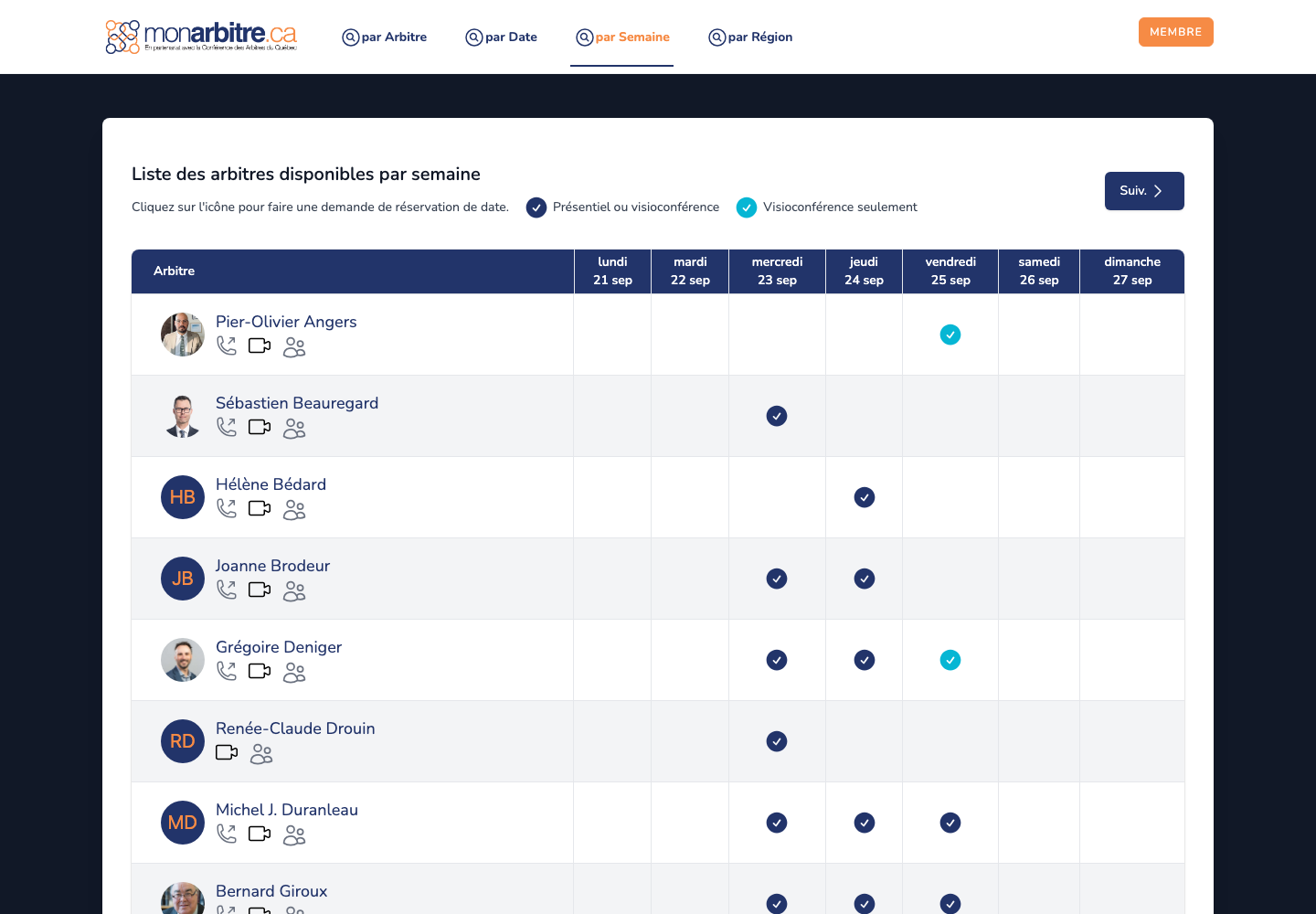
01 The friction
Not enough availability, or not enough visibility?
A group of grievance arbitrators and mediators came to CodeMountain, one of my businesses, through mutual contacts. Québec’s labour ministry (ministère du Travail) and some of the parties using their services wanted more transparency about availability, and appointing more arbitrators was being considered. The group believed the capacity was already there. People just couldn’t see it.
Before anyone could work on the dispute, everyone had to land on the same date.
A much larger government IT proposal was already on the table. The group wanted something practical they could put to use quickly. We started with how a date actually got agreed.
The arbitrator’s office, union representatives and employer representatives coordinated by phone and email. Finding a date could take weeks, and the back-and-forth took roughly 6–10 hours a week of assistant time.
02 The change
Show the dates. Make the request easy to handle.
We walked through who needed which information, what made a date usable, and what the assistants had to do with each incoming request. Availability had several sides: in person or by videoconference, in the arbitrator’s usual region or during a planned visit elsewhere.
Mon Arbitre was built around those answers. The office publishes its availability. Parties search by arbitrator, date, week or region, then send a request with what the office needs to handle it. Every request arrives in the same format, so the assistants know where to find each detail.
Before
- Call
- Send an email
- Compare calendars
- Start again
Now
- See the dates
- Send one request
- The office confirms
03 Simpler work
A few minutes to keep everyone on the same dates.
Instead of answering the same availability questions one call at a time, the assistants spend a few minutes every other day reviewing and publishing the schedule. Parties see the options before they contact the office.
Four ways to find a date
- By arbitrator
- By date
- By week
- By region
A request is not an automatic booking. The office still contacts the parties and confirms the date. What changed is the starting point: dates everyone can see, and a request that is ready to process.
In their words
With the new features, it’s exactly what I had in mind. We save so much time and back-and-forth that our executive assistants can’t do without Mon Arbitre anymore. Martin, you rock!
04 The result
Fewer calls. The open dates were already there.
How I measured this My estimates from the offices’ routine, kept as separate measures and not added together: roughly 6–10 hours a week of assistant time coordinating dates before; a few minutes every other day publishing availability after; one or two exchanges per request.
Before deciding a business needs more resources, it helps to see what’s already available, and what gets in the way of using it.
- 6–10 h a week of assistant time coordinating dates, before
- A few min every other day to publish availability, after
- 1–2 exchanges per request, and the office still confirms the date
The published schedules also gave the group a concrete way to show the ministry and the parties the availability that already existed.
It took about three months from needs analysis to a tool the offices could use. The arbitrators’ association couldn’t fund the whole project upfront, so CodeMountain offered it as a subscription, with a purchase price agreed in advance.
After two years, the association secured funding, including a grant, and bought the tool at that price: a small fraction of what the government had proposed charging. They shaped how it works, and now they own it. CodeMountain still runs the infrastructure and handles the more complex technical support.
Mon Arbitre is also the example behind the Just Asking approach on the home page: follow one real job and find what’s missing.
Is your team spending its week agreeing on dates? Let’s talk