My own product · GetTrail
Trail conditions, rebuilt every morning
One update. Every place your visitors look.
Every morning, someone rebuilt the trail grid, then handed it off to the website and to social media. Now the team updates statuses once and publishes in seconds. It started with a question over coffee.
Visit GetTrail Managed by my company PixelTrail
What changed · The daily update
Before: roughly 30–45 minutes preparing the daily update, plus handoffs to the webmaster and social media. After: roughly 10–30 seconds updating statuses in GetTrail, depending on network size.
How I measured thisIn a client’s words Plein Air Sainte-Adèle: about 30 minutes every morning, now under a minute. Read the quote

01 The friction
Four mornings. The same trail list.
My CodeMountain partner and I were working from a café. Four mornings in a row, a friend who looked after a trail network sat nearby, spending about 45 minutes on what looked like a PowerPoint presentation. Eventually, we asked what they were preparing.
The team knew its trails. Getting that knowledge to visitors was taking far too much work.
It was a list of trails: open, closed, current conditions. The information people needed before heading out, rebuilt every morning.
Then the images went to a webmaster for the website, and someone else took pieces for social media. One update had become a small relay race. So we asked who did what, in what order, and where the information had to go.
02 The change
The first fix helped. It didn’t finish the job.
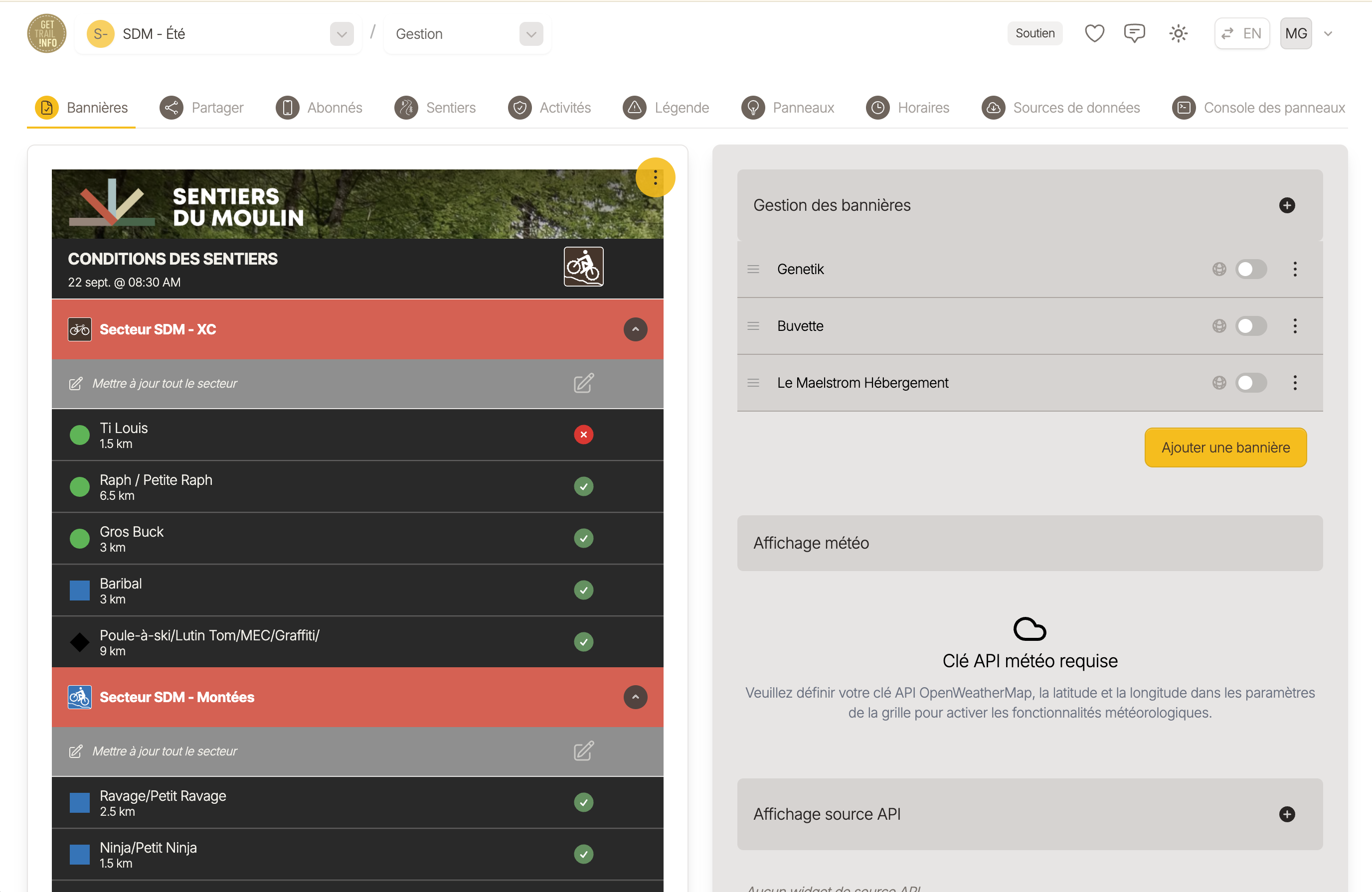
We built a small WordPress plugin: a trail grid with buttons to change statuses and enter conditions. The website update came down to roughly 5–15 minutes.
After a few weeks, what remained was obvious. Someone still made images for social media, and the feed filled up with yesterday’s grid, today’s grid, another grid. Visitors still had to find the current one.
The next version became GetTrail: trails, activities and their statuses in one place, set up for summer and winter. Change what changed, publish, and get on with the day.
Before
- Prepare the grid
- Make the images
- Send them out
- Republish
Now
- Update the statuses
- Website and link follow
03 Simpler work
One place to update. One link to keep.
GetTrail feeds the website automatically and gives the network a public page with a permanent link. The network pins that link on social media once, instead of posting a new image every day. Visitors see the latest statuses and when they were updated.
One update, where visitors look
Update the statuses
- The website, fed automatically
- A public page with a permanent link
- Social media, where that link stays pinned
The rest of the work got lighter too:
- An email on a schedule the team chooses, every 24 hours for example, with the current grid: confirm it’s still right, or change it. Confirming records who did it.
- Each person manages their own part: a sector of the network, the skating rink, the pool.
- Close the whole network at once, or schedule a closure at 5 p.m. and restore the previous statuses at 8 a.m.
- Every change and confirmation goes into an activity log that can be kept for more than two years, to look back at how a closure was communicated.
In their words
Our users always want to know what’s open, what’s closed and what the trails are like. Across nearly 250 kilometres and 10 sectors, that update took us about 30 minutes every morning. With GetTrail, it takes less than a minute.
A complete product, a clear interface and, above all, a real working relationship taking shape between us.
04 The result
Seconds to publish. Fewer handoffs.
How I measured this My own estimates, observed, not timed: 30–45 minutes to prepare the morning grid at the first network, not counting the handoffs that followed; roughly 5–15 minutes with the WordPress plugin; 10–30 seconds to update statuses in GetTrail, the longer end on larger networks.
The useful change was one place to update what the team knows, then letting that information travel.
-
The morning grid
preparing it, before sending images to the website and social media
30–45 min
-
The WordPress plugin
updating the grid on the website
5–15 min
-
GetTrail
updating statuses once, depending on network size
10 to 30 seconds
Referrals brought other trail networks, then municipal sports and recreation teams with the same problem at skating rinks, tennis courts and pools. We built a version for those facilities too.
Then came the trailhead.
You shouldn’t have to climb for 45 minutes to find out the trail you came for is closed. That led to PixelStream: connected LED panels showing the same statuses on site. A mobile app and notifications are planned next.
Does your team enter the same update in several places? Let’s talk