
The AI is installed and everyone has a login. It turns out a quote in two minutes. And the customer still waits for an answer just as long as before.
The short version
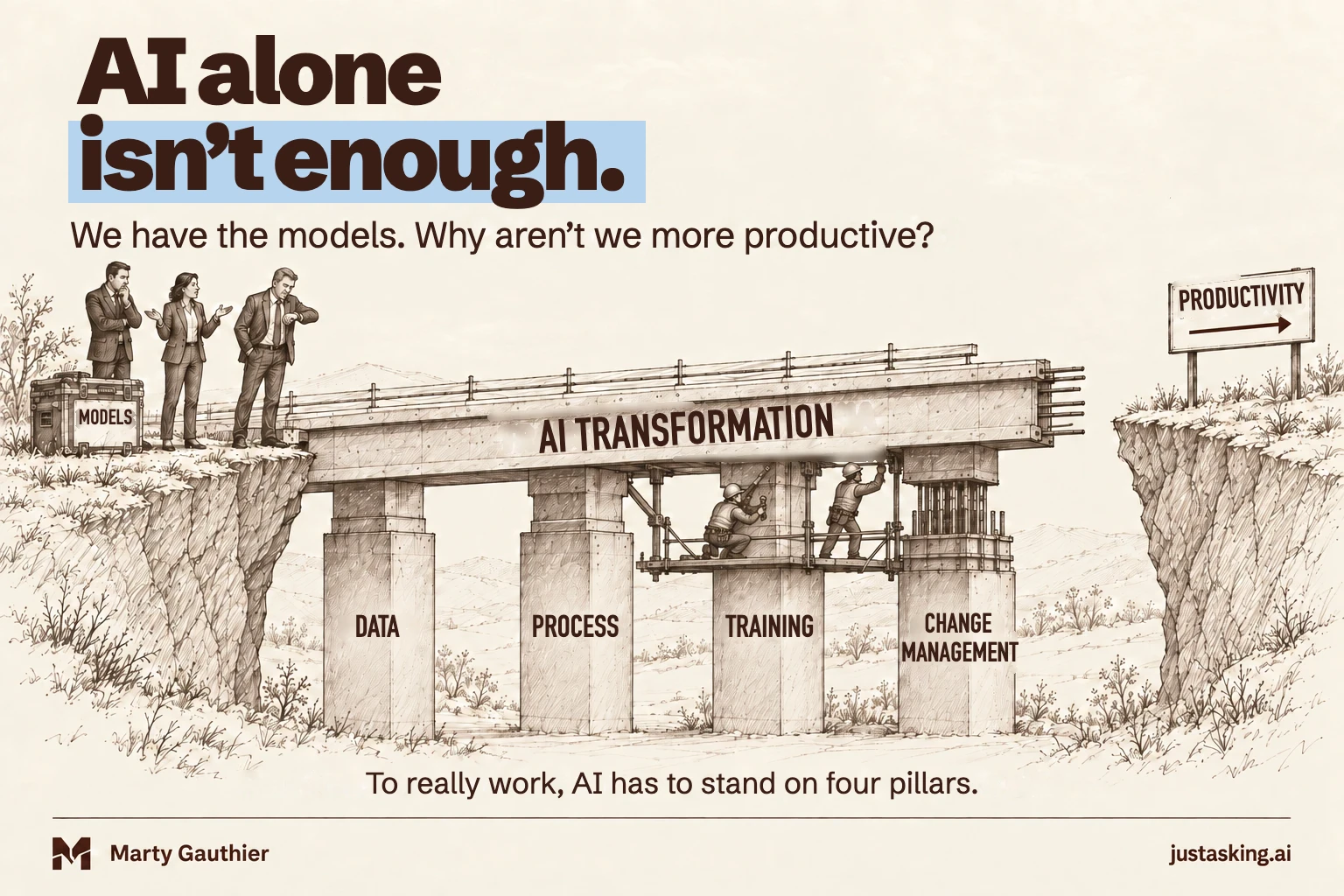
AI doesn’t stand on its own. It rests on four pillars, namely your data, your process, training and change management. Take one of your processes, follow a real case, look at them one at a time, and start with the weakest. The steps
The AI is set up. Why aren’t we more productive?
It works for any process: purchasing, invoicing, after-sales service, hiring. I’ll use sales as the example, because everybody has a sales process: a request comes in, someone puts a quote together, the customer orders, you deliver, you invoice.
Say you’ve plugged AI into quoting. That step is faster, no question. Except the right price lives in someone’s head. The quote waits for an OK. The person using it doesn’t trust it. And your rep keeps texting requests to you. At the end of the line, the customer sees no difference.
You’re not alone in this. Economists even have a name for it, the “J-curve”: a technology like AI first asks you to rework how you do things and train your people, and the gains come after. If you’re curious, the study is here .
So the real question: what is your AI standing on?
What you’ll have in hand at the end.
A two-page worksheet. Your process on one side, your four pillars on the other, each with a rating (solid, needs work or missing), on one real process. And a decision: which one gets shored up first.
Personally, I’d plan an hour or two with the right people around the table. That’s an estimate; it depends on your people and the number of steps.
Worksheet
The four pillars worksheet. Print it before the meeting and fill it in by hand, one pillar at a time.
The steps
- Follow a case
- Data
- Process
- Training
- Change
What it takes.
- one process only, the one where AI is already plugged in or about to be (in my example, sales);
- the people who really do it, at each step (in sales: whoever builds the quotes, whoever enters orders, whoever invoices);
- five recent cases, with their emails and documents;
- a sheet of paper or a whiteboard.
No need to reopen the demo. We’re looking at what’s underneath.
Follow one case, start to finish.
Take one of the five cases and retrace it with the people who lived it. Put the stops on one line, four to six, no more. For sales, that gives: request, quote, order, delivery, invoice. Under each, note who did what, with which information, and where it waited.
One tip: take a real case, detours and all, not the perfect one from the slide deck. When everyone at the table says “yes, that’s what happened,” you’ve got it.
Keep the line in front of you. We’ll reread it four times, one pillar at a time.
Data: where’s the right information?
AI works with what you give it. At each stop on the line, three questions.
Where’s the right version?
Whatever the step needs to move forward. In one place, or several?
Who keeps it current?
Someone with a name, or whoever thinks of it.
What lives only in someone’s head?
The unwritten rule, the exception you make every time.
In a sale, it looks like this. The price list exists in three versions: the office Excel file, the PDF sent to the reps last year, and what you know by heart for your oldest customers. The AI uses the Excel file. The quote goes out fast. With the wrong price.
How do you know it’s fine? Ask two people the same question (in sales: that customer’s price). If they give the same answer without calling you, it’s solid. And no need to clean up all your data before you start, only what this process uses.
Process: who does what, who decides?
AI speeds up one step. The process is everything that happens between the steps, and that’s often where things wait.
Who does what, at each stop?
And who takes over when that person is on vacation?
Who decides, and how far?
Up to what amount, or what kind of case, without you?
Which approval is still there out of habit?
It was useful once. Is it still?
In a sale, it looks like this. The quote is ready in two minutes. Then it sits on your desk, because every quote goes through you, even the ones at list price. And you’re at a customer’s until Thursday.
Automate a detour and you get a faster detour. Before speeding up a step, it’s worth asking whether it still does anything.
The test: does an ordinary case reach the end without going through you? If so, it’s solid. If not, we’ve just plugged AI into the process as is, detours included.
Training: knowing how to judge what comes out.
Knowing where to click is the easy part. The real training is being able to judge what the AI proposes.
Do they know what to check before it goes out?
Three or four points. A short checklist, always the same.
Do they know what to do when the AI gets it wrong?
Fix it, say so, and to whom.
Did they get time to learn, on real cases?
Time set aside in the schedule, not taken from lunch.
In a sale, it looks like this. The person who does the quotes got a password and a twenty-minute demo. They don’t know when they can trust the result. So they redo every quote by hand, beside it, to compare. Twice the work.
One number, for context. According to Statistics Canada , in the second quarter of 2026, 19.2% of Canadian businesses said they had used AI in the previous 12 months. Among them, 44.4% had changed something in their training or staffing because of AI. The others reported no change on that front.
It’s solid when the person can explain, on a real case, why they accepted or corrected what the AI proposed. If all they were shown is the buttons, half the training is missing.
Change: closing the old path.
This is the pillar people forget, and I’m the first to do it. Geek that I am, I think about the tech before I think about the habits. But changing a habit is work, and it needs a plan.
What changes in each person’s day?
Say it for each person, not for “the team.”
What do we stop doing, and starting when?
As long as the old path stays open, people keep taking it.
Who answers questions in the first weeks?
Someone with a name, and time set aside for it.
In a sale, it looks like this. A month later, your rep still texts requests to you, and you answer from your truck. It’s easier for the rep, and you answer fast. The AI serves one person, for whatever comes in by email.
It’s solid when the old path is closed, everyone knows since when, and nobody was surprised. An email sent on a Friday afternoon doesn’t count as a plan.
An example, start to finish.
Here’s what the worksheet could look like at a distributor, for its sales process, after the meeting. It’s an illustrative example, not a client case.
- Data: needs work. Three price lists.
- Process: needs work. Every quote waits for an approval.
- Training: missing. One demo, no checklist.
- Change: missing. The texts keep coming.
Where to start? With the process. Quotes at list price go out without approval, and the others come back to you. Then a single price list. The AI itself hasn’t changed one bit.
Before
- A request comes in
- The AI builds the quote
- It waits for your OK
- The customer gets an answer
After the first pillar
- A request comes in
- The AI builds, someone checks
- At list price, it goes out
- The customer gets an answer
The order matters: the information and the ways of working first, the tech after.
How to tell it worked, and the limits.
A month after your first change, redraw the line with a new case. If it still waits in the same place, the pillar isn’t solid yet.
This exercise doesn’t pick the app for you. It doesn’t tell you whether you need AI either. Sometimes a single up-to-date list fixes the problem, and that’s great news. And if three pillars out of four are missing, start with a smaller process.
If the line is hard to draw because everyone sees it their own way, an outside view helps. That’s what we do together in Define.
-
Do all four pillars have to be perfect?
No. Solid enough for this one process. A bridge doesn’t need marble pillars.
-
We’ve already paid for the AI. Too late?
Not at all. Run the exercise on the process where it’s used. That’s often where you see why it’s used so little.
-
Which pillar do we start with?
The weakest. If two are tied, the one you can shore up this week.
Read the note on naming the problem
You already have the AI. The bridge is yours to build.
Sources
- Analyse de l’utilisation de l’intelligence artificielle par les entreprises au Canada, deuxième trimestre de 2026 (Statistique Canada)
- Analysis on artificial intelligence use by businesses in Canada, second quarter of 2026 (Statistics Canada)
- The Productivity J-Curve: How Intangibles Complement General Purpose Technologies (Brynjolfsson, Rock and Syverson, NBER Working Paper 25148)